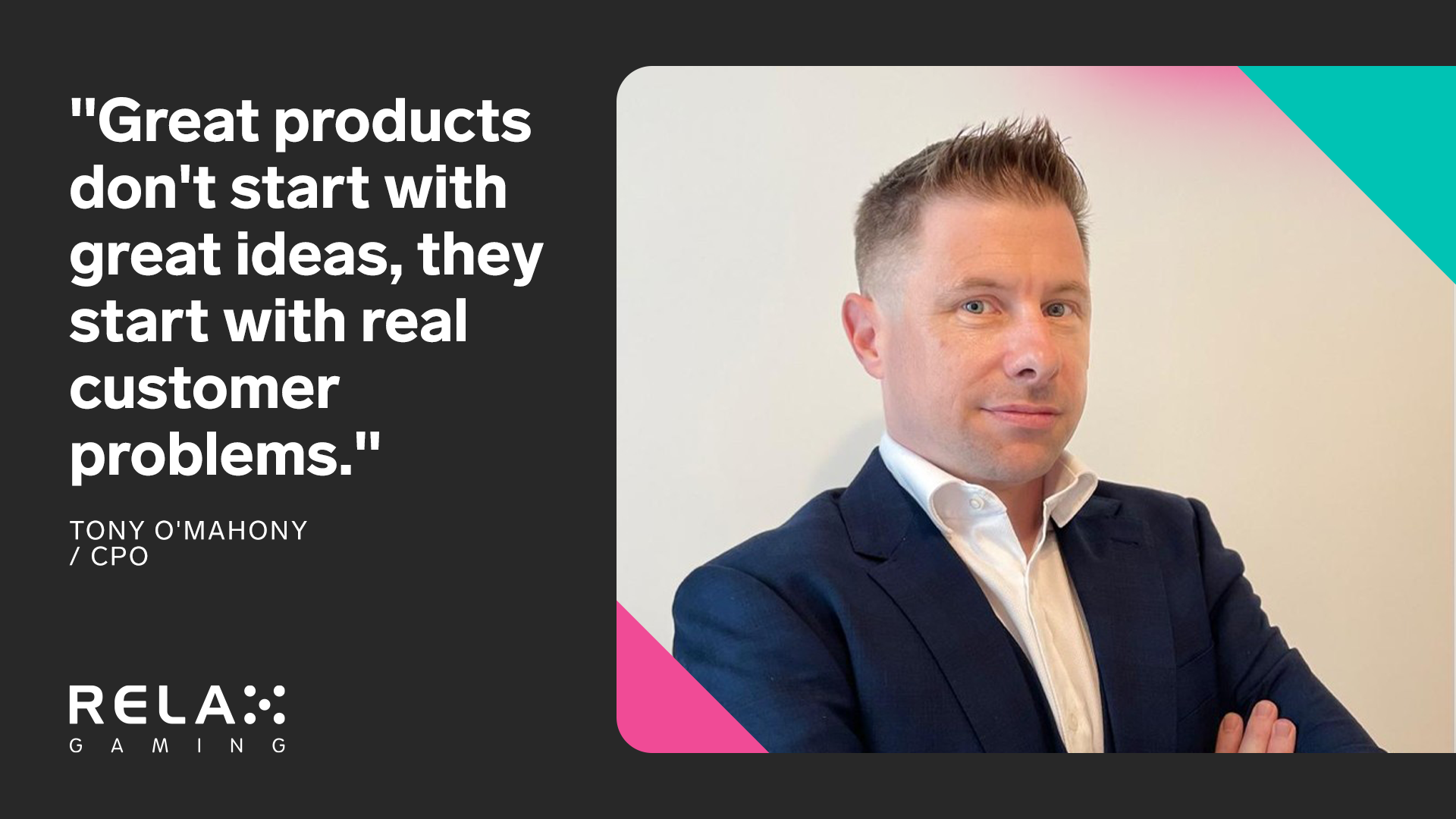
Read the interview as posted by iGaming News Today below or in full on their website here.
Building successful products in today's iGaming industry requires much more than great ideas. As technology evolves, AI reshapes product development, and customer expectations continue to rise, product leaders must balance innovation, responsible gaming, and long-term strategy while creating experiences that deliver genuine value.
In this exclusive interview with iGaming News Today, Tony O'Mahony, Chief Product Officer at Relax Gaming, shares his insights on building successful product strategies, fostering innovation, leveraging AI, creating high-performing teams, and the future of product leadership in the global gaming industry.
The biggest lesson I've learned is that great products don't start with great ideas - they start with real customer problems. Early in my career, like many product people, I spent too much time thinking about features. Over time, I realised that customers don't buy features; they buy outcomes, experiences, and solutions to problems. I've also learned that product development is a team sport. The best products come from engineering, design, data, commercial teams, marketing, and customers working together around a shared vision. No single person has all the answers. Finally, I've learned the importance of focus. Great product teams aren't defined by how much they build, but by having the discipline to decide what not to build and staying focused on the goals that matter most.
Successful product strategies begin with clarity of purpose. Everyone in the organisation should understand who the product is for, what problem it's solving, and how success will be measured. Average strategies often try to be everything to everyone, while great strategies make deliberate choices about where they won't compete. Execution is equally important. Strategy isn't just about having a roadmap - it's about continuously learning from customers, adapting quickly, and staying focused on long-term goals. Most successful products aren't built through one breakthrough moment, but through consistently making good decisions over time.
I think AI will fundamentally change how product teams work, but probably not in the way people first expected. Its biggest impact won't simply be generating code or artwork - it will be helping teams make better decisions faster. AI can analyse player behaviour, identify opportunities earlier, generate prototypes more quickly, and automate many repetitive tasks that slow product development today. Within iGaming, I see AI playing an important role in personalisation, improving operator tools, and helping identify responsible gaming signals earlier. That said, I don't believe AI will replace creativity or product judgement. Human understanding of players, emotions, and experiences will remain essential.
Innovation has to be intentional. If every deadline is critical and every roadmap is fixed, people naturally become risk-averse. That's why it's important to create space for experimentation while still maintaining accountability. Not every experiment will succeed, and that's okay. The key is to validate ideas early, test assumptions quickly, and learn from the outcomes. I also believe innovation isn't always about creating something completely new. Often, the most valuable innovations are small improvements that make the player or operator experience meaningfully better. Creating a culture where it's safe to make mistakes is what allows innovation to flourish.
I don't see innovation and responsible gaming as competing priorities - they actually reinforce each other. Better data allows us to create more personalised experiences, but it also helps identify unusual behaviour, provide timely interventions, and support healthier play. The industry's responsibility is to use technology to build long-term trust rather than maximise short-term engagement at any cost. Sustainable businesses are built by creating entertainment that players can continue to enjoy responsibly, and product teams have an important role in embedding those principles from the earliest stages of design.
High-performing product teams share several common characteristics. First, they have complete clarity of purpose. Everyone understands the vision and what success looks like. Second, they're deeply curious. They spend most of their time understanding customer problems before trying to solve them. They're also highly collaborative because the best product decisions rarely come from one individual - they come from different perspectives working together. Finally, they're comfortable making decisions with imperfect information. Product development is about continuous learning, and the strongest teams combine ambition with the humility to change direction when the evidence tells them to.
I think product leadership will become less about managing roadmaps and more about orchestrating intelligent systems. As AI automates more execution, product leaders will spend less time asking, "Can we build this?" and more time asking, "Should we build this?" Judgement, ethics, prioritisation, and strategic thinking will become even more valuable because those are areas that can't simply be automated. I also believe product leaders will increasingly act as translators, helping engineering teams, commercial teams, regulators, and customers navigate rapidly evolving technologies. While technology will continue to change, the core responsibility will remain the same: understand customers, solve meaningful problems, and create products that people genuinely value.
Relax Gaming Ltd is licensed and regulated in Great Britain by the Gambling Commission under account number 37462.
Relax Gaming is licensed and regulated in a number of jurisdictions. All our licences can be found here.
© 2019-2026 Relax Gaming Group. All Rights Reserved.
